
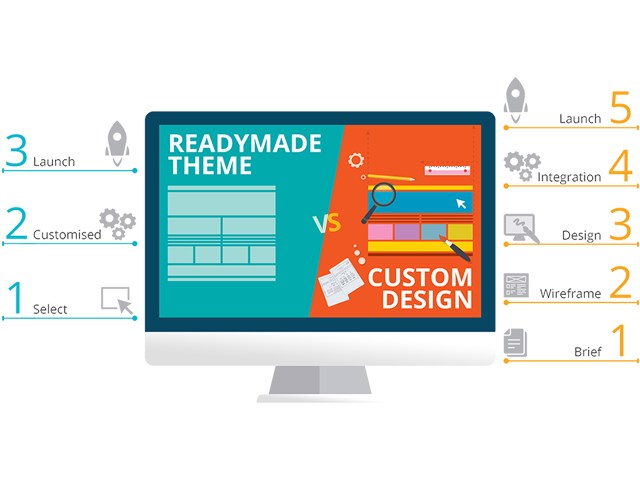
A third-party theme can be a sensible starting point when it matches the requirements and remains maintainable.
Compare customization against future maintenance
A third-party theme can be a sensible starting point when it matches the requirements and remains maintainable. Custom work can be justified when the brand, content or functionality needs a different structure. Compare editing flexibility, performance, extension dependencies and upgrade work. The useful choice is not determined by the label custom or template, but by how well the finished system supports the business.
Introduction:
Imagine you’re about to build your dream home. You’d want it to be unique, reflecting your personality and style. The same goes for your website design. It should be a true representation of your business, with all the essential features and easy navigation. In this blog post, we’ll explore the advantages and disadvantages of custom and third-party theme-based web design to help you make an informed decision.
Pros:
Preview and Customization: With theme-based design, you can preview, modify, and visualize the final product before launching it. This gives you a clear idea of how your website will function and look.
Customized Themes: There are numerous pre-designed themes tailored to specific niches, making it easier to select a theme that fits your business needs. You can customize the font, color, portfolio, and content layout to suit your preferences.
Support Team: Theme-based web design comes with a support team that assists you with any technical issues before, during, or after the launch.
Cons:
Lack of Originality: With so many websites using the same themes, there’s a risk of losing originality and standing out from the crowd.
Limited Customization: Pre-structured themes offer limited customization options, with set page formats that you must adhere to.
Custom Web Design Toronto:
Unique Design: Custom web design ensures that your website is one-of-a-kind, reflecting your brand’s personality and values.
Complete Control: With custom web design, you have control over every detail, from colors and fonts to layouts, social media integration, and plugins.
Higher Costs: Custom web design is more expensive than theme-based design because developers have to build it from scratch.
Creative Differences: Designing a website is a creative process, and too many opinions can lead to decreased productivity and long waiting times.
Turn the business goal into a clear website brief
Start by naming the action a useful visitor should complete. A service company might need an accurate quotation request, while a training provider needs people to find the correct course and understand its prerequisites. These are different journeys even if both organizations ask for a modern website. Write down the audience, the questions that delay their decision and the information the team needs to respond. This short brief is more useful than choosing a visual style before the problem is understood.
Build the sitemap around those decisions. Separate services when they have different buyers, deliverables or buying questions. Keep closely related information together when splitting it would force readers to jump between thin pages. Agree who supplies photography, approves copy and owns each integration. A project schedule should include these dependencies, because a finished layout cannot compensate for missing product information or an unanswered policy question.
A practical acceptance checklist makes the brief testable. Ask whether a first-time mobile visitor can identify the service, confirm that it is relevant, find supporting evidence and complete the next step. Check the enquiry from submission through to the person responsible for replying. Record anything that requires training or ongoing maintenance before approving launch.
Choose WordPress features with an ownership plan
WordPress can support many types of websites, but the quality of the result depends on its configuration and maintenance. Start with the content editors' tasks: publishing an article, updating a service, changing an image and reviewing an enquiry. Decide which capabilities belong in the theme, which belong in a plugin and which need a separate integration. Business-critical content should not disappear when a visual theme is changed.
Keep the extension list purposeful. Evaluate support history, compatibility, permissions and the need for an ongoing licence. Avoid adding several plugins that attempt to control the same caching or security function without a clear reason. Use a staging copy for significant changes and keep a recoverable backup before updating the production site.
Handover should cover administrator ownership, publishing roles, renewal responsibilities and a simple update process. Demonstrate common editing tasks using the actual site. Check what happens when an editor uploads a large image or enters a long heading. A manageable website requires both suitable software and sensible guardrails. Review the site periodically for unused accounts, outdated components and broken integrations instead of waiting for a visible failure.
Use images and visual hierarchy to explain the offer
Choose visuals that answer a question: what a finished project looks like, how a process works, which product variant is being sold or what customers should expect. Original project screenshots and appropriate photographs often provide more useful evidence than interchangeable stock images. Keep the subject relevant to the surrounding section and write a caption when its purpose would otherwise be unclear. Avoid treating a generic office photograph as proof of a particular team or location.
Prepare several appropriate sizes rather than serving an oversized original everywhere. Reserve the image's space so text does not jump as it loads, and avoid placing essential information only inside the bitmap. A chart, price or instruction should also be available as readable text. The first prominent image needs different loading treatment from images far below the fold, which can usually wait until the reader approaches them.
A coherent visual system also needs restraint. Use heading size, spacing and contrast to show which information belongs together. Check how the page looks with a long headline, a missing optional photograph and enlarged text. If the layout works only with perfectly cropped sample content, editors will struggle to maintain it. Keep approved source files, usage permissions and concise image descriptions with the project handover.
Reduce operational risk with recoverable changes
Security work should begin with the systems and information the business depends on. Keep an inventory of websites, domains, hosting accounts, integrations and the people who own them. Remove unnecessary access, use strong authentication where supported and keep essential software maintained. A tool labelled secure cannot compensate for abandoned administrator accounts or an undocumented dependency.
Backups need a recovery plan. Decide what is included, where copies are stored and how often the data changes. Test restoration into an isolated environment and confirm that the recovered site includes both files and database content. Record the steps and the people who can carry them out. A backup job that reports success is useful evidence, but a successful restore is stronger evidence of recoverability.
For changes, keep a rollback path and avoid altering unrelated settings during an incident. Record the symptoms, recent deployments and relevant logs before attempting a repair. Restrict access to secrets and personal data during investigation. After service is restored, identify the cause and improve the process that allowed it. Clear ownership and tested recovery often matter more to a small business than an impressive list of tools with nobody assigned to operate them.
For guidance tailored to your business, explore our Custom Website Design or request an audit.
Want advice specific to your website?
We can review the current experience, search visibility and conversion path, then prioritize improvements by likely impact.
Request a website audit